
Every GRC tool is now boasting AI functionality, but what exactly does this mean? And how can you evaluate one tool against another?
This checklist gives you the key questions to ask when evaluating an AI tool for CMMC, so you can separate hype from software that will actually help you pass your C3PAO assessment.
What is AI for CMMC?
AI for CMMC can include any artificial intelligence feature that uses machine learning, natural language processing, or other automated intelligence to help with compliance tasks.
One of the most common forms of AI for CMMC is a chat-based AI assistant that lets you type a question and get an instant answer. In a compliance context, that might mean asking for a plain-language explanation of a control, drafting an implementation statement, or clarifying which evidence to submit.
But not all of these tools are created equal. Some are built on generic internet data and offer advice that’s outdated or inaccurate. Others don’t protect your CUI or integrate with your existing workflows, which can create new risks instead of reducing them.
Keep reading for a closer look at how to evaluate AI tools for CMMC so you can reduce risk and get the best return on your investment.
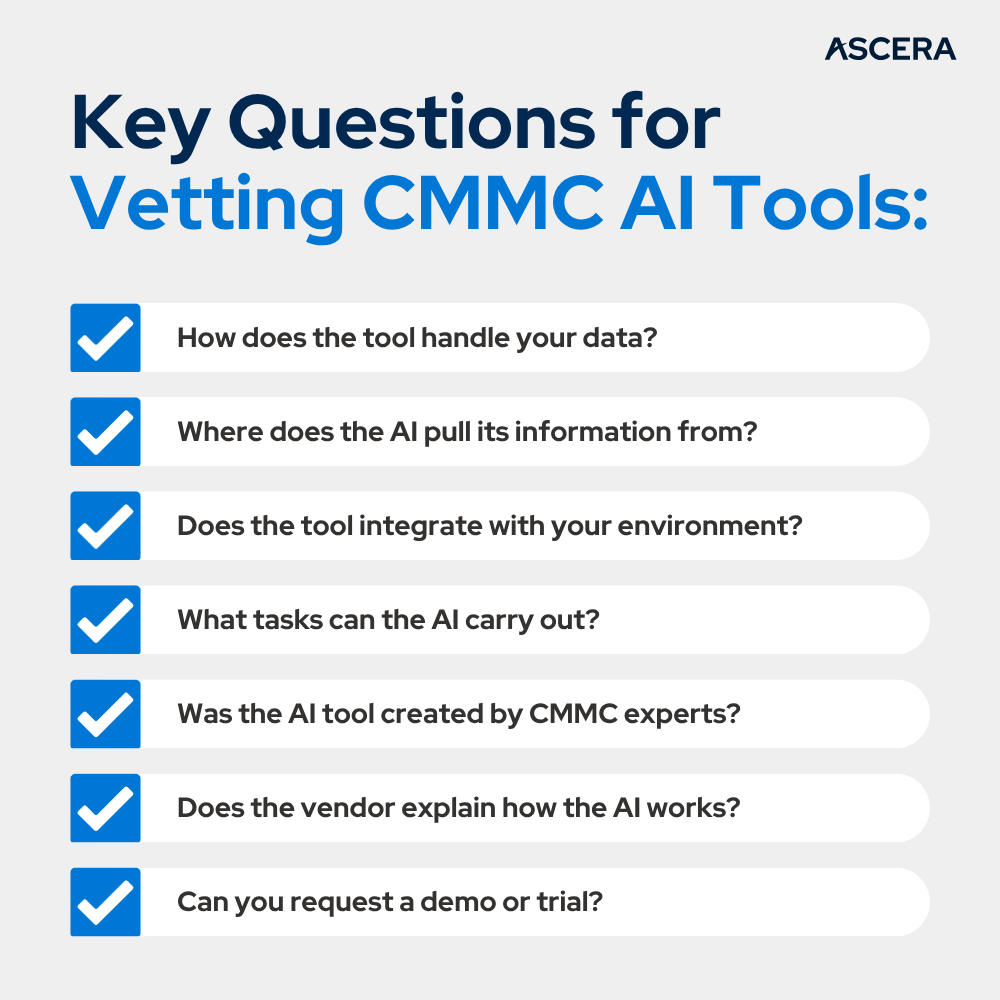
How to Evaluate an AI Tool for CMMC: 7 Key Factors
1. Data Security
Question to ask: How does the tool handle sensitive information?
CMMC involves Controlled Unclassified Information (CUI), which must be protected at all times. Uploading parts of your SSP, logs, or evidence into a public AI model is a compliance risk in itself. A trustworthy tool will have a layered defense strategy, combining multiple security measures — such as access control, encryption, monitoring, and user training — to ensure the confidentiality, integrity, and availability of your data. The tool’s website should clearly spell out how your data is stored and processed.
Look for:
- Assurances that data is never sent to public AI models or used for training
- Encryption in transit and at rest
- Hosting options that meet government security standards, like AWS GovCloud
- Clear documentation on how prompts and outputs are handled
2. CMMC Training
Question to ask: Is the AI trained specifically on CMMC/NIST data?
Generic AI tools are trained on broad internet data, which means they can pull in outdated or unverified information. They can also “hallucinate,” giving responses that sound plausible but aren’t accurate. A reliable CMMC AI tool should be built on expert-vetted content and clearly disclose its sources.
Look for:
- AI models trained specifically on CMMC and NIST 800-171 content
- Disclosure of what sources the model draws from
- Assurance that the materials used for training were chosen by CMMC experts
3. Seamless Integration & Grounding
Question to ask: Does the AI tool integrate with your compliance data and ground into your environment?
An AI assistant isn’t useful if you have to constantly copy and paste material into a chat box or if it sits outside your everyday processes. The best tools allow you to workshop your own SSPs, POA&Ms, and implementation statements in real time — securely, without leaving your environment — while presenting an intuitive interface your team will actually want to use.
An AI tool should be grounded in context. This means that when users ask a question, the tool uses techniques like Retrieval Augmented Generation (RAG) to automatically retrieve the relevant policies, parameters, and live operational data to return an answer tailored to the user’s environment. Here’s a deeper look at RAG in CMMC AI tools.
Look for:
- Ability to interact directly with your existing compliance documentation
- Secure, private processing of your data without exposing CUI externally
- A user-friendly interface that minimizes training and speeds adoption
- Integration with your existing compliance workflows
4. Practical Value
Question to ask: What tasks does the AI actually make easier?
AI should do more than rephrase definitions. The best tools help you move compliance work forward in concrete ways.
Look for:
- Drafting implementation statements
- Identifying the right evidence for each control
- Clarifying overlapping requirements
- Breaking down complex controls into plain English
- Highlighting gaps in existing documentation
5. Vendor Credibility
Question to ask: Was the AI tool created by people who actually know CMMC?
A vendor’s credibility matters. Tools built by general software teams with no CMMC experience can miss key requirements or misinterpret controls. Look for a product team with assessor credentials, a history of working with DoD contractors, and a proven track record in compliance.
Look for:
- Clear involvement of Certified CMMC Assessors or other recognized experts
- Published credentials or partnerships that show domain expertise
- References or case studies from organizations like yours
6. Vendor Transparency
Question to ask: Does the vendor explain how their AI works?
You don’t need a technical whitepaper, but you do need enough clarity to know the AI is built responsibly. Be cautious of vendors that market “black box” AI without explaining what sources it relies on.
Look for:
- Clear explanation of data sources (preferably assessor-vetted)
- Details on where your data goes
- Commitment that customer prompts won’t be used to train public models
7. Ability to Try a Demo
Question to ask: Can you request a demo or trial?
A reputable vendor should be confident enough to let you see the tool in action with your own use cases. Demos or trial access give you a chance to test features, see how your data is handled, and evaluate the user experience before committing.
Look for:
- The ability to book a live demo with product experts
- Trial environments or sandbox access
- Opportunities to test real CMMC scenarios
Conclusion
AI can be a game-changer for CMMC, but only if it’s secure, framework-aware, and built for assessment readiness. By asking the right questions up front, you can avoid the risks of public or generic AI tools and choose a platform that actually helps your team succeed.
With ASCERA’s ComplyAI, you get an AI assistant designed exclusively for CMMC — secure by design, assessor-created, and practical for the real tasks contractors face every day. Try it for free to see if ComplyAI is right for you.